Wednesday, November 18, 2009
Reflections from Chuck Rarick
Today was a very interesting day. The group visited a social enterprise which builds housing for the poor. A good example of some career choices for MBA students who may seek another route with their lives. It was of interest to many, but of special interest to a few who are already involved in such ventures. Our day was also interesting in our choice for lunch ..... a small place that has a very good chocolate dish with fruit.


Jennifer Fredricks' reflections on Chilean food
Dinners have been wonderful and from all corners of the world. The combinations of cultures are evident in dishes such as this one...scallops in coral sauce. We had dinner in a French restaurant but the amazing seafood of Chile was the main course in this dish.


Jacinda Yerga's reflections
Buenos dias, most of you know that I started the program by making 90% of my decisions based on intuition. After concluding many classes in this esteemed MBAE program I am shocked to find myself thinking in a different manner. As we have all learned studies show that even simple decisions are better made using decision analysis. When Jennifer and I were walking through the wine tanks yesterday (see picture below) our professors would be proud of the model we recreated starting with the decision node and moving along the sequence of events telling a beautiful story of wine moving from point A to point B in the most cost effective manner. We of course laughed the whole way!
The two words supply and demand have been spoken by each speaker we have heard thus far. It is a simple concept but I studied economics vigorously and all the late nights are paying off. The graph is my friend one I intend to keep for a lifetime.
My hope and wish would be to also keep the rest of my cohorts as lifelong friends. I am having a great time with each person here and miss the rest of you. The Andes Mountains are beautiful, out of all the places John and I have traveled the wine and food is by far the best. John even mentioned retiring here. We learned that Chile needs education reform, maybe I will take Spanish lessons after graduation. Could you all see me in front of a classroom as a teacher?
Cheers, Jacinda
The two words supply and demand have been spoken by each speaker we have heard thus far. It is a simple concept but I studied economics vigorously and all the late nights are paying off. The graph is my friend one I intend to keep for a lifetime.
My hope and wish would be to also keep the rest of my cohorts as lifelong friends. I am having a great time with each person here and miss the rest of you. The Andes Mountains are beautiful, out of all the places John and I have traveled the wine and food is by far the best. John even mentioned retiring here. We learned that Chile needs education reform, maybe I will take Spanish lessons after graduation. Could you all see me in front of a classroom as a teacher?
Cheers, Jacinda
Tuesday, November 17, 2009
Kevin Hoffmeyer's thoughts on Chile
 In a short amount of time, the group has developed a basic understanding of the Chilean economy, major business sectors, and the people. Our pace has been steady, but the best way to increase learning is from the immersion and direct exposure that we have encountered.
 Our hosting companies to date have been extremely gracious and willing to answer all of our questions posed - no matter the sensitivity. This openness to develop our learning of Chile has been appreciated by all. As we have also witnessed, an MBA covering the ‘big picture’ of business is beneficial for leadership and entrepreneurial success.
Thanks to Austral for their coordination of activities and added insight of the Chilean culture and economy. I truly look forward to the remaining company discussions and the opportunity to meet personnel from my Corp. based in Santiago tomorrow.
Jennifer Fredricks' reflections
 Chile is truly an amazing place! Both its government and private structures are open to implementing new methodology, which is serving them well.
Brad Krieger on the Errazuriz Winery
Being a huge wine fan, the prospect of visiting Chile immediately grabbed my attention. I truly believe that in order to understand a new culture, you have just dive in. In the past, that attitude has led me to eating unidentifiable sea creatures, smoking a pretty rough hookah in Palestine or eating more saurkraut than anyone should ever endure. In Chile, however, it means sampling premium wines and gourmet food.
Today's visit to Errazuriz didn't disappoint. If your local Trader Joe's sells Chilean wine, it's likely they don't stock anything of this caliber. I'm glad our guides chose quality over quantity.
The wines we sampled had body and texture that truly put them in the leagues with the big dogs of Europe and California. They said that they're a mix of old world and new, but I'd put them much further into the new. The carmenere, Chile's star varietal, was outstanding. But the highlight of my day was a sampling of the Don Maximiano Founder's Reserve. Wow. Forget sea bass. Fly to South America to try this wine. So smooth, it tasted like a big piece of red velvet cake.
All of the wines were paired with an incredible meal of seafood, meat and fresh pressed avacodo oil from the area. The food was just as good as the wine.
My favorite thing about this visit was the laid-back and easy-going nature of the entire experience. It was food that could stand up in NY with wine of Napa and Bordeaux quality but with zero attitude, expectation or drunken wine trollies. The Chilean wine experience may be one of the most underrated luxuries in the world. Muy bueno!!
Today's visit to Errazuriz didn't disappoint. If your local Trader Joe's sells Chilean wine, it's likely they don't stock anything of this caliber. I'm glad our guides chose quality over quantity.
The wines we sampled had body and texture that truly put them in the leagues with the big dogs of Europe and California. They said that they're a mix of old world and new, but I'd put them much further into the new. The carmenere, Chile's star varietal, was outstanding. But the highlight of my day was a sampling of the Don Maximiano Founder's Reserve. Wow. Forget sea bass. Fly to South America to try this wine. So smooth, it tasted like a big piece of red velvet cake.
All of the wines were paired with an incredible meal of seafood, meat and fresh pressed avacodo oil from the area. The food was just as good as the wine.
My favorite thing about this visit was the laid-back and easy-going nature of the entire experience. It was food that could stand up in NY with wine of Napa and Bordeaux quality but with zero attitude, expectation or drunken wine trollies. The Chilean wine experience may be one of the most underrated luxuries in the world. Muy bueno!!
Day 3 - Exportadora El Parque & Errazuriz Winery
It was another excellent day in Chile - and yet one so very different from yesterday. We continue to learn more about the country and its economy and understand the opportunities and issues in doing business here. Today's visits took place about two hours outside of Santiago. Both were housed at the Errazuriz Winery.

 Our first visit was with Sr. Sebastian Bulnes who is the owner of Exportadora El Parque. This company integrates a number of large growers in the commercialization of their products. The company has more than 1,000 hectares planted with avocados, table grapes and citrus. They primarily market to the US, Europe, and Asia. In fact, if you have grapes or avocados at home right now, chances are good that they came from El Parque.
 Of particular interest to our MBA students was the fact that the business model for El Parque was developed five years ago by Sr. Bulnes as a project in his final class (Entrepreneurship and New Venture Formation) for his MBA at the Kellogg School of Management (Northwestern University). The business model tries to eliminate distributors and link producers and retailers more closely together.
 Chile has four advantages which are creating the conditions for the country to become a world food power: 1) a mediterranean climate and and ecologic island status which protects the country from diseases and pests thus reducing costs associated with eliminating these, 2) they are counter season with the most important markets for food exporting - US, Europe, Asia, 3) Free trade agreements - Chile has FTA's with more than 88% of the world's GDP, and 4) committed management with know how to do business in more than 100 countries.
 Following Sr. Bulnes' presentation, we took a very interesting, precarious bus ride up to the orchards to see their avocado fields. Once there the group divided in two and in turns went further up into the fields. We learned that a single plant can produce 20 kilos of fruit per year. All the fruit is harvested by hand and it takes about three weeks for the fruit to get from the tree to your supermarket. Interestingly, the fruit can be "stored" on the tree after it is ripe. They simply get larger and richer. El Parque uses high density farming. In the past, approximately 100 trees were planted per hectare. Now they plant 1100 trees per hectare. They intentionally keep the trees small and dense. The picture below is of "baby" avocado still on the tree. It will take approximately nine months for these to mature.
 Our day in the Aconacagua Valley continued with a visit to the Errazuriz Winery and an excellent presentation by Sr. Luis Enrique Izquierdo. We were all looking forward to this and were not disappointed. The winery is a boutique firm focused on producing premium wines. Their challenge is to grow the market for Chilean wines as a whole and to differentiate themselves strategically.
 A key date for the company was January 23, 2004 at a blind tasting in Berlin. Chilean wines triumphed over wines from Bordeaux and Tuscany. Wines from Errazuriz took first and second places (Sena and Maximiliano Founder's Reserve brands) in the tasting by wine experts from around the world. This success has been repeated many times elsewhere around the world. This is, in fact, a key aspect of the winery's marketing program. Placing an ad in Wine Spectator (a leading industry magazine) costs $25,000 US dollars -yes, you read this right!. The tastings are a more effective way to reach the opinion leaders and grow the reputation of Chilean wines. Recently Eduardo Chadwick - the current CEO and decendent of the founder - was named the 39th most important person in the wine world, in large part because of the quality benchmark that the winery produces.
 The winery aims for excellence in all strategic areas and pursues a differentiation strategy based on five factors: 1) brand image, 2) owning their own vineyards, 3) emphasis on human resources, 4) distribution with international partnerships (did you know that the UK drinks more wine per capita than anywhere else in the world???), and 5) development of iconic wines.
 Following an excellent lunch hosted by the vineyard with tastings of white, red, and a sweet dessert wine, we were given a comprehensive tour of their facilities including a gorgeous new building for their iconic wines. This building is designed in the shape of a spiral that turns the same way water flows in the southern hemisphere. It also is designed to be very kind to the wine, using gravity whenever possible rather than forcing the wine through pipes in an un-natural manner.
 Then came the really tough decision - what to buy to bring home? It was a difficult decision among excellent alternatives and we got back on the bus with lighter wallets but completely happy. We only wish we could have taken home this much wine!

 Our first visit was with Sr. Sebastian Bulnes who is the owner of Exportadora El Parque. This company integrates a number of large growers in the commercialization of their products. The company has more than 1,000 hectares planted with avocados, table grapes and citrus. They primarily market to the US, Europe, and Asia. In fact, if you have grapes or avocados at home right now, chances are good that they came from El Parque.
  Of particular interest to our MBA students was the fact that the business model for El Parque was developed five years ago by Sr. Bulnes as a project in his final class (Entrepreneurship and New Venture Formation) for his MBA at the Kellogg School of Management (Northwestern University). The business model tries to eliminate distributors and link producers and retailers more closely together.
 Sr. Bulnes told us that food is Chile's second most important export. Overall, Chilean exports are forecasted to drop 25% in the next year, but food exports are forecasted to grow 9% to at least $13.5 billion US dollars. If this happens, food exports could represent 25% of Chilean exports in 2010. Food products are one of the most stable sectors in the country.
 Chile has four advantages which are creating the conditions for the country to become a world food power: 1) a mediterranean climate and and ecologic island status which protects the country from diseases and pests thus reducing costs associated with eliminating these, 2) they are counter season with the most important markets for food exporting - US, Europe, Asia, 3) Free trade agreements - Chile has FTA's with more than 88% of the world's GDP, and 4) committed management with know how to do business in more than 100 countries.
  Following Sr. Bulnes' presentation, we took a very interesting, precarious bus ride up to the orchards to see their avocado fields. Once there the group divided in two and in turns went further up into the fields. We learned that a single plant can produce 20 kilos of fruit per year. All the fruit is harvested by hand and it takes about three weeks for the fruit to get from the tree to your supermarket. Interestingly, the fruit can be "stored" on the tree after it is ripe. They simply get larger and richer. El Parque uses high density farming. In the past, approximately 100 trees were planted per hectare. Now they plant 1100 trees per hectare. They intentionally keep the trees small and dense. The picture below is of "baby" avocado still on the tree. It will take approximately nine months for these to mature.
 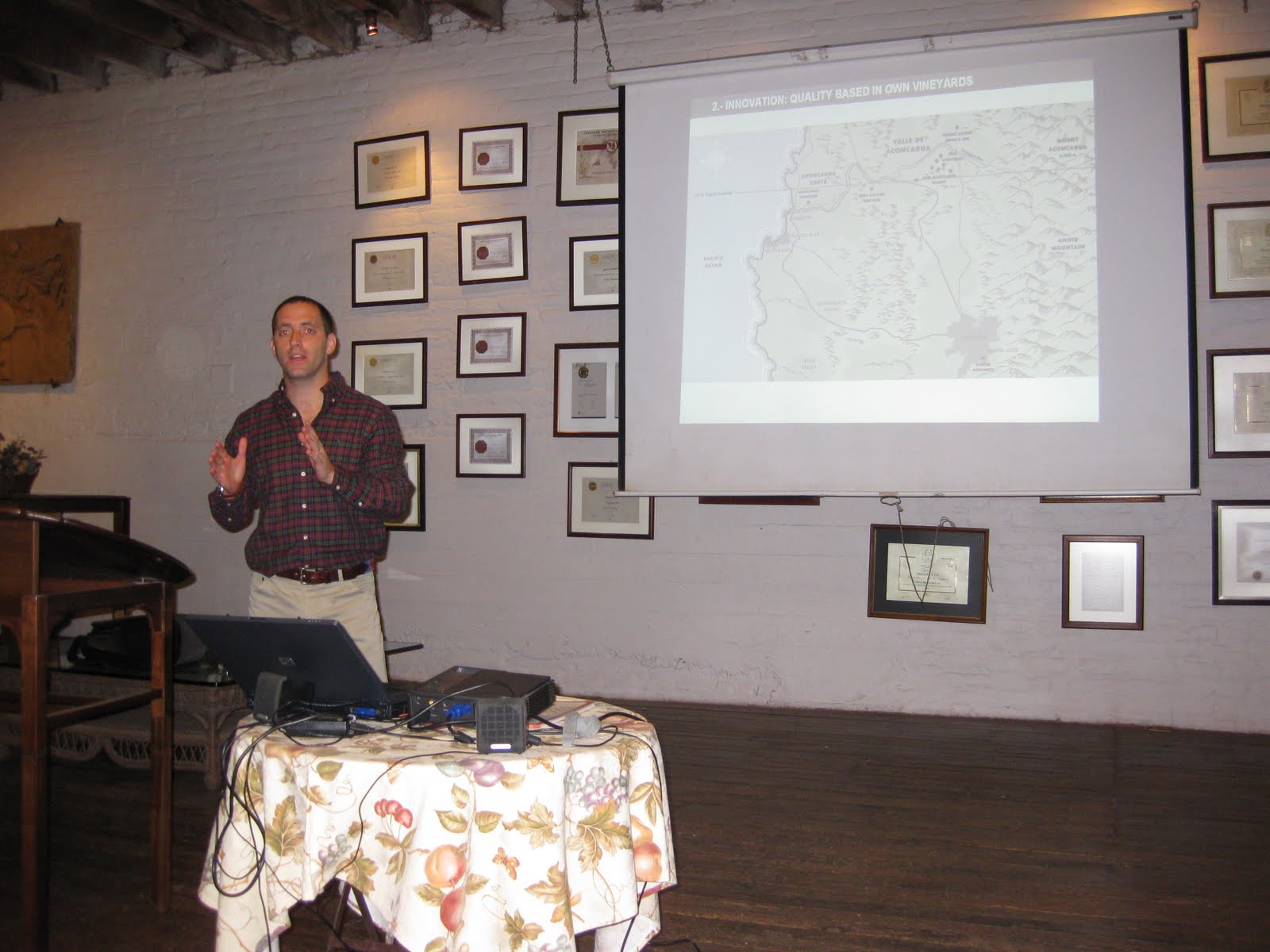 Our day in the Aconacagua Valley continued with a visit to the Errazuriz Winery and an excellent presentation by Sr. Luis Enrique Izquierdo. We were all looking forward to this and were not disappointed. The winery is a boutique firm focused on producing premium wines. Their challenge is to grow the market for Chilean wines as a whole and to differentiate themselves strategically.
  A key date for the company was January 23, 2004 at a blind tasting in Berlin. Chilean wines triumphed over wines from Bordeaux and Tuscany. Wines from Errazuriz took first and second places (Sena and Maximiliano Founder's Reserve brands) in the tasting by wine experts from around the world. This success has been repeated many times elsewhere around the world. This is, in fact, a key aspect of the winery's marketing program. Placing an ad in Wine Spectator (a leading industry magazine) costs $25,000 US dollars -yes, you read this right!. The tastings are a more effective way to reach the opinion leaders and grow the reputation of Chilean wines. Recently Eduardo Chadwick - the current CEO and decendent of the founder - was named the 39th most important person in the wine world, in large part because of the quality benchmark that the winery produces.
  The winery aims for excellence in all strategic areas and pursues a differentiation strategy based on five factors: 1) brand image, 2) owning their own vineyards, 3) emphasis on human resources, 4) distribution with international partnerships (did you know that the UK drinks more wine per capita than anywhere else in the world???), and 5) development of iconic wines.
 Following an excellent lunch hosted by the vineyard with tastings of white, red, and a sweet dessert wine, we were given a comprehensive tour of their facilities including a gorgeous new building for their iconic wines. This building is designed in the shape of a spiral that turns the same way water flows in the southern hemisphere. It also is designed to be very kind to the wine, using gravity whenever possible rather than forcing the wine through pipes in an un-natural manner.
  Then came the really tough decision - what to buy to bring home? It was a difficult decision among excellent alternatives and we got back on the bus with lighter wallets but completely happy. We only wish we could have taken home this much wine!
Monday, November 16, 2009
Day 2 - Enjoyment
 Along with our excellent business visits, we also had time for some enjoyable meals and conversation. After the visit to the Ministerio de Hacienta, some of us went to the lovely Provedencia neighborhood, by subway, and had lunch at two adjacent restaurants. This neighborhood is also home to the Austral Group - our hosts in Chile. We were thrilled to find the only vegetarian restaurant (El Huerto) in Santiago as we are travelling with three vegetarians and one vegan. The food presented there was beautiful and I'm told was also delicious.
  Another group ate at the restaurant two doors down, Bistrot Boca. Here is a picture of our menu and of part of the group eating there. Chirimoya is a local fruit that is very sweet. The John, Jacinda, Mike, and Jeff (to the right) got to taste the mousse, but unfortunately they ran out for the rest of us. The owner was nice enough to give us some chirimoya juice so we could at least taste this new fruit.
  It was a lovely, long, civilized, Latin American lunch taken at about 1:00 pm. We had some delicious wine with lunch and thoroughly relaxed. It was really nice to get into a neighborhood and eat as the locals do.
 Our dinner was equally excellent. We had our welcome dinner at the lovely Akarana Restaurant. Upon arrival, we were able to relax on the patio and enjoy a pisco sour, wine, or some wonderful fresh juices. The rasperry juice was delicious! When we moved inside, we took up most of the tables in this small but lovely restaurant. Below are some pictures from the dinner. Yes, that last one is of men's underwear (with names) - it was hanging in the women's bathroom. I am told that there is a similar work of art in the men's room.


Day 2 - Empresas Copec
In the afternoon, our education continued at Empresas Copec. Epreseas Copec is Chile's largest publicly traed company. It's market capitalization is $19 billion dollars which is more than 10% of the total market capitalization for the entire country. Empresas Copec is a financial holding compan for their subsidiary business in natural resources and energy.
 Our speakers at Empresas Copec were Sr. Rodrigo Huidobro, the Chief Financial Officer (industrial and civil engineering degree from the Catholic University of Chile and MBA from MIT), and Sr. Jorge Ferrando, the Business Development Officer (industrial and civil engineering degree from the Catholic University of Chile and PhD from La Sorbonne).
Sr. Huidobro noted that Empresas Copec wants to be in sectors in which they can lead. Currently they hod the number two market whare world wide in pulp products, the number one market share of sawn timber market in Latin America and 65% of the fuel distribution market which is the largest in Chile.
They are a financially strong company with an EBITDA of between 1.6 and 1.8 and a debt to equity ration of 0.5. They have a conservative and healthy financial structure.
 Of their divisions, Forestry accounts for 75% of their assests and 76% of their income, however Fuels account for 76% of their sales. This is due to fuel being a very low margin business. Their forestry business is both vertically and horizontally integrated. The pine trees they grow in Chile grow faster than most places in the world - it takes a pine tree 25 years to reach maturity her versus 100 years in the United States.
 Their fuels businesses are solely distribution companies. They do not produce fuels. Copec is the largest auto fuel distributor in the country and it consistently outperforms the market in terms of operating efficiency due to their prime locations and extraordinarly high brand recognition. They hold approximately 60% share of the market.
 Here are some pictures of us waiting for the bus after the presentation. The picture on the left is of Pam, Selena, Jennifer, and Shontrai from MBAE10 who travelled with us to China. And the picture on the right is of Shontrai and his friend and our colleague from Indiana University Northwest, Dr. Vernon Smith.
 Our speakers at Empresas Copec were Sr. Rodrigo Huidobro, the Chief Financial Officer (industrial and civil engineering degree from the Catholic University of Chile and MBA from MIT), and Sr. Jorge Ferrando, the Business Development Officer (industrial and civil engineering degree from the Catholic University of Chile and PhD from La Sorbonne).
 Sr. Huidobro noted that Empresas Copec wants to be in sectors in which they can lead. Currently they hod the number two market whare world wide in pulp products, the number one market share of sawn timber market in Latin America and 65% of the fuel distribution market which is the largest in Chile.
They are a financially strong company with an EBITDA of between 1.6 and 1.8 and a debt to equity ration of 0.5. They have a conservative and healthy financial structure.
 Of their divisions, Forestry accounts for 75% of their assests and 76% of their income, however Fuels account for 76% of their sales. This is due to fuel being a very low margin business. Their forestry business is both vertically and horizontally integrated. The pine trees they grow in Chile grow faster than most places in the world - it takes a pine tree 25 years to reach maturity her versus 100 years in the United States.
  Their fuels businesses are solely distribution companies. They do not produce fuels. Copec is the largest auto fuel distributor in the country and it consistently outperforms the market in terms of operating efficiency due to their prime locations and extraordinarly high brand recognition. They hold approximately 60% share of the market.
  Here are some pictures of us waiting for the bus after the presentation. The picture on the left is of Pam, Selena, Jennifer, and Shontrai from MBAE10 who travelled with us to China. And the picture on the right is of Shontrai and his friend and our colleague from Indiana University Northwest, Dr. Vernon Smith.
Love Kalra on Ministerio de Hacienda
Comment on the education part noted in the prior post - A point was raised by one of our cohort in the question and answer session. It was asked "To be competitive in the global services Chileans has to be fluent in English or at least should be taught English as a language in the school" and our speaker Sr. Igal Magendzo replied "for Chilean government the current focus is to provide students of Chile with the basic education and after that only they will be looking into anything (English education) else". After the session with the ministry we had a informal discussion with our group guides and they gave us a very good insight to the Chile education system from the public school teachers perspective and all the problems teachers have been facing and how they go on strike whenever government does not meet their demand which actually effects the future of the students.
Day 2 - Ministerio de Hacienda
What an absolutely wonderful first business day! On a personal note, our day started with the excellent news that Professor Rarick was feeling better and would indeed be joining us here in Chile. He will be meeting us here after our visits tomorrow.
 Our first visit of the day was to the Ministerio de Hacienda (Finance Ministry) where we were hosted by Sr. Igal Magendzo and Sra. Pamela Arreano. Sr. Magendzo is the Macroeconomic Coordinator for the Ministerio and Sra. Arreano is a macroeconomic policy advisor for the Ministerio. Sr. Magendso gave a wonderfl presentation which brought to life the reasons analysts refer to the "Chilean miracle" of economic stability. In simple terms, the hilean government has a "Fiscal Rule" which states that they will spend only structural income (vs. actual revenues) and that any windfall income will be saved and allocated to the Pension Reserve Fund, the Central Bank capitalization, and the Economic and Social Stabilization Fund. The Chilean government's income comes primarily from two places: taxes (71%) and copper (29%). The structural income mentioned above is a combination of a forcast of GDP and copper prices for the upcoming year. As a result of "The Rule" Chile's social expenditure spending is countercyclical - that is they spend more during difficult times.
Finally, he noted that education is the number one priority of the Chilean government if they want to be able to continue to compete in the world economy. He believes that future growth will come from global services such as financial services and this will clearly require an educated workforce.
 Our first visit of the day was to the Ministerio de Hacienda (Finance Ministry) where we were hosted by Sr. Igal Magendzo and Sra. Pamela Arreano. Sr. Magendzo is the Macroeconomic Coordinator for the Ministerio and Sra. Arreano is a macroeconomic policy advisor for the Ministerio. Sr. Magendso gave a wonderfl presentation which brought to life the reasons analysts refer to the "Chilean miracle" of economic stability. In simple terms, the hilean government has a "Fiscal Rule" which states that they will spend only structural income (vs. actual revenues) and that any windfall income will be saved and allocated to the Pension Reserve Fund, the Central Bank capitalization, and the Economic and Social Stabilization Fund. The Chilean government's income comes primarily from two places: taxes (71%) and copper (29%). The structural income mentioned above is a combination of a forcast of GDP and copper prices for the upcoming year. As a result of "The Rule" Chile's social expenditure spending is countercyclical - that is they spend more during difficult times.
 Sr. Magendzo noted that Chile has gone from having a more volitile economy than average in the region to now having a more stable than average over the last three decades. He also noted that Chile has the fourth highest average growth rate in GDP in the world over the last 30 years after only China, Malaysia, and Ireland. In addition, Chile has the lowest risk premium of all Latin American Countries.
Regarding the current worldwide financial crisis, Sr. Magendzo noted that Chile has the most aggressive combination of fiscal spending in a recession and reduction of interest rates to stimulate spending. They are able to do this because of the surpluses they've achieved (currently $10 billion dollars down from approximately $36 billion dollars before the crisis). Speaking to the stability of the economy, he noted that no other country has suffered a sharper drop in exports while at the same time having its GDP contract at the lowest rate.
Sunday, November 15, 2009
Day 1 - Touring Santiago
Buenas noches! After the orientation and lunch, we had a very interesting tour of the city of Santiago. Here are a few random facts that we found out on this tour:
 Our first stop was the Plaza de la Constitucion where La Moneda was. Our guide, Gustavo, told us many interesting things about this city and country including what the three colors in the Chilean flag stand for - he said that it was based on the French concept of liberte, egalite, and fraternite (apologies for misspellings). Surrounding this main plaza are many government buildings including the one housing the Ministerio de Hacienda where we will be tomorrow morning.

 We then got back on the bus for a ride to our next stop. We were lucky to wait for the bus next to this fountain - that water felt so nice! A sign in the bus said the outside temperature was 30 degrees celsius! That is 86 Farenheit for the rest of us! What made this all the more amazing was the snow that we could see capping the mountains. It was also quite striking to notice that many, many of the apartment balconies had an abundance of folliage growing on and from them. It seems as though the owners had created their own abundant outdoor space.
 Following this we went to the Centro Artisanal de Los Dominicos which was a very quaint shopping areas of small shops. This was were we got our first sight of goods made from lapuz lazuli - a beautiful blue stone that is only found in Chile and Afghanistan. Lapaz is used to make all kids of goods from jewelery to letter openers, to the seemingly upbiquitious penguins. The water is very cold along most of the Chilean coast and penguins are often found further north than you might expect.

- The name Santiago means St. James
- The population in Santiago is 6 million - in Chile as a whole 16 million
- The oldest church in Santiago is the San Francisco Church which was finished in 1618 - two years before the pilgrims came to Plymouth Rock on the Mayflower. It is also the oldest building in Santiago.
- The Government Palace is called La Moneda (The Mint) which is what it was originally used for. It was built in 1805. It is now the Chilean equivalent to our White House, however it doesn't house the head of state. The President is "homeless". The Chilean government doesn't provide housing for the head of state so they choose where they live.
- The inflation rate in Chile for this year is NEGATIVE 0.1%.
 Our first stop was the Plaza de la Constitucion where La Moneda was. Our guide, Gustavo, told us many interesting things about this city and country including what the three colors in the Chilean flag stand for - he said that it was based on the French concept of liberte, egalite, and fraternite (apologies for misspellings). Surrounding this main plaza are many government buildings including the one housing the Ministerio de Hacienda where we will be tomorrow morning.
 Following that we saw the Chilean stock exchange as well as strolling along the Alemeda and the Paseo Ahumada.

We spent significant time at the Plaza de Armas - the city's historic center and what is said to be the actual center of the city. The first corner of the plaza brought us to this very interesting statue in honor of native americans. We understand that this caused no little controversy when it was erected. You can see the entire group in this picture. We also saw the statue of Santiago's founder Pero de Valdivia - pictured, of course, on a horse.
 We then got back on the bus for a ride to our next stop. We were lucky to wait for the bus next to this fountain - that water felt so nice! A sign in the bus said the outside temperature was 30 degrees celsius! That is 86 Farenheit for the rest of us! What made this all the more amazing was the snow that we could see capping the mountains. It was also quite striking to notice that many, many of the apartment balconies had an abundance of folliage growing on and from them. It seems as though the owners had created their own abundant outdoor space.
  Following this we went to the Centro Artisanal de Los Dominicos which was a very quaint shopping areas of small shops. This was were we got our first sight of goods made from lapuz lazuli - a beautiful blue stone that is only found in Chile and Afghanistan. Lapaz is used to make all kids of goods from jewelery to letter openers, to the seemingly upbiquitious penguins. The water is very cold along most of the Chilean coast and penguins are often found further north than you might expect.
Thus concluded our tour of Santiago. We went back to the hotel and went our separate ways. Many went to the Patio Bellavista. This was a charming "town square" area with a number of restaurants and shops. One of the most fun, and tempting, was the crepe stand where we treated ourselves to crepes with fruit and chocolate or fruit and dulce de leche. What a great way to start a meal!
Day 1 Update
We have arrived in Santiago! We came in two batches but all arrived safely. We only had one lost piece of luggage and we hope they will find it quickly. The flights were uneventful. We got to watch movies we hadn't seen because we've been so busy - I was thrilled to get to watch "Julie and Julia".
Here is a screen shot of the map showing our flight path - we went over Cuba and then down the west coast of South America. It was about an eight and a half hour flight from Miami to Santiago.

 Leticia, Aureliano, Hugh, Maria Jose and Maricruz Larrea (our program manager for the trip) went to a lovely new restaurant near the Museum of Visual Arts. The patio where we had breakfast was a visual feast unto itself. It featured a large piece of the Berlin Wall - right in Santiago! We had a traditional breakfast of coffee or hot chocolate, fresh orange juice, and toast with avocado. The latte that Aure and I had was so beautifully presented - another piece of art!
 Following that we headed back to the hotel for the Orientation Meeting. There we met up with the rest of our group. Maricruz gave us a thorough introduction to Chile and what to expect - she reminded us that we should adapt to Chile and not expect Chile to adapt to us. In particular she said to remember that things are a bit slower here and that there is a lot of kissing (on the cheek) when greeting each other.
 At the orientation meeting we met up with Shaun Sheffield and Barrett Helmet. Shaun is originally from Muncie, IN and founded the Austral Group as part of a project for his MBA program. Barrett is the Sales Manager and was our original contact for this trip. That's Barrett on the left and Shaun on the right. We also met our other host for the week, Claudia Fernandez.
Here is a screen shot of the map showing our flight path - we went over Cuba and then down the west coast of South America. It was about an eight and a half hour flight from Miami to Santiago.

Note: You can always DOUBLE CLICK on any photo to enlarge it.
When we got into Santiago those holding US passports paid the $131 reciprocity fee and then we all went through customs. After picking up our luggage we met Maria Jose Garcia, one of our hosts, and took the bus to the hotel. Because we arrived so early in the day, our rooms weren't ready yet. So, a few of us went out for bruch.
 Leticia, Aureliano, Hugh, Maria Jose and Maricruz Larrea (our program manager for the trip) went to a lovely new restaurant near the Museum of Visual Arts. The patio where we had breakfast was a visual feast unto itself. It featured a large piece of the Berlin Wall - right in Santiago! We had a traditional breakfast of coffee or hot chocolate, fresh orange juice, and toast with avocado. The latte that Aure and I had was so beautifully presented - another piece of art!
 Following that we headed back to the hotel for the Orientation Meeting. There we met up with the rest of our group. Maricruz gave us a thorough introduction to Chile and what to expect - she reminded us that we should adapt to Chile and not expect Chile to adapt to us. In particular she said to remember that things are a bit slower here and that there is a lot of kissing (on the cheek) when greeting each other.
  At the orientation meeting we met up with Shaun Sheffield and Barrett Helmet. Shaun is originally from Muncie, IN and founded the Austral Group as part of a project for his MBA program. Barrett is the Sales Manager and was our original contact for this trip. That's Barrett on the left and Shaun on the right. We also met our other host for the week, Claudia Fernandez.
We are all now resting, showering, blogging, and otherwise amusing ourselves until our tour of Santiago at 3:30. We will write more this evening.
Saturday, November 14, 2009
To leave a comment
Just click on the word "comments" below any post. This will bring up a dialog box where you can leave your comment.
Tuesday, November 10, 2009
Follow MBAE-11's Study Abroad trip to Chile
Welcome! We invite you to come back often to follow the progress of the MBAE's study abroad trip to Chile. The links to the right will connect you with all of the companies and places we will be visiting. There are also links to news and articles about Chile - in particular about Santiago and Valparaiso.
Subscribe to:
Posts (Atom)